
Sympathy and Memorial Keepsakes: What Is Appropriate, What to Avoid, and When to Send
By Eternal Rose editorial · Published · Updated
Send flowers for the service and a keepsake later — an engraved, permanent object lands better weeks after the funeral than in the first few days, when the house is already full of arrangements and no one has room to think about them. The Hospice Foundation of America is direct about this: do not abandon the grieving person shortly after their loss, and keep checking in through the weeks and months that follow. A keepsake that arrives then is one way of doing that. Before ordering anything engraved, confirm the spelling of the name and both dates with someone close to the family, because an engraved plate cannot be corrected afterwards.
Timing: the quiet weeks matter more than the first week
In the days after a death the family is managing arrangements, visitors and paperwork. Flowers, food and practical help fit that week. A keepsake does not — it asks for a reaction, and there is nothing left to give one with.
The Hospice Foundation of America's guidance for supporting someone grieving makes two points that translate directly into timing. First, there is no finish line for grief, and support should continue 'during the weeks and months that follow'. Second, offers of help work better when they are specific rather than open-ended — the example given is asking 'Can I arrange grocery deliveries for the next month?' rather than 'let me know if you need anything'.
A workable rule: something practical in week one, a note in week three, and a keepsake at a month or later, or on one of the dates below.
Check the engraving before you order anything
Engraved memorial pieces are personalised at manufacture and cannot be amended. The listings in this catalog show what you will be asked to supply: the memorial cases come with a 4 x 3 inch gold or silver plate engraved with the person's name, birth date, death date and a message; the museum-case version carries a 2 x 3 inch engraved plate and an engraved photo; on the rosewood version, the name and death date can be imprinted directly on the rose petal.
Before ordering, confirm four things with someone close to the family: the exact spelling of the full name, including any middle name or maiden name they actually used; both dates; whether the family uses a nickname or the formal name on markers; and whether anyone has already commissioned something similar. Two nearly identical engraved cases is an awkward outcome that a single message prevents.
What to avoid
The Hospice Foundation's list of things not to do is short and worth following literally: do not claim to understand their experience or compare losses; do not suggest the death was 'for the best'; do not impose a timeline on their mourning. It also suggests specific questions such as 'What do you have planned for today?' work better than a vague 'How are you feeling?'.
Three practical additions on the gift itself:
- Avoid anything that needs care. A living plant is a chore handed to someone with no capacity for chores. A sealed, permanent object asks nothing.
- Avoid deciding where it lives. A large display piece claims shelf space in a shared home. Smaller is kinder unless you know the household wants it.
- Avoid surprising the household. If the death was recent and the object is prominent, mention it is coming.
The dates that matter most
The Hospice Foundation names birthdays, anniversaries and holidays as moments that are particularly hard for someone grieving, and advises being aware of them. These are also the moments when almost no one else remembers, which is precisely what makes a message or a keepsake land on them.
Put these in a calendar now, while you still remember them: the person's birthday, the date of the death, their wedding anniversary if a spouse survives them, and the first Christmas or equivalent holiday. A note on the first anniversary of a death, from someone who did not have to be reminded, is often remembered longer than anything sent in the first week.
What this catalog actually offers, plainly
So you know the range before you look: there are six memorial-specific listings, priced $161.95 to $197.95. They are variations on the same idea — a real 8-inch or 11-inch rose, preserved and either trimmed or fully dipped in 24k gold, silver or platinum, set in a lined case with an engraved plate. Case options are an acrylic museum case at 14 x 4 x 3.5 inches, a leatherette case with black felt lining at 12.5 x 8.25 x 3.75 inches, and a rosewood case at 14 x 4 x 4.5 inches. One version carries a stars-and-stripes petal imprint for a service member.
Two smaller and less conspicuous options exist. A personalised crystal bud vase engraved with a dove and the person's name and dates is $62.95 and holds up to three 11-inch roses, so it can be used with fresh flowers afterwards. And for a family-tree display, individual 1.5 inch engraved hearts with the person's name, birth date, birthstone, death date and an angel symbol are $35.05.
What this catalog does not sell: urns, cremation jewellery, or any wearable memorial item. If that is what is wanted, look elsewhere.
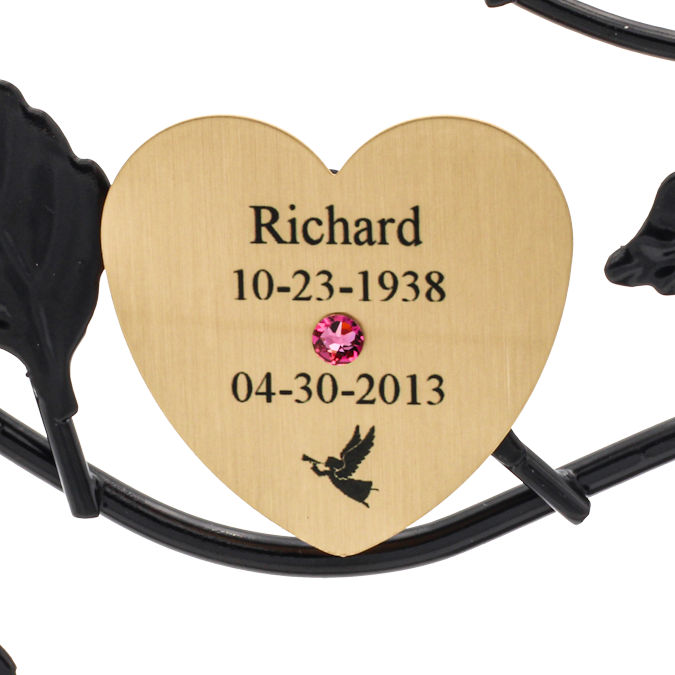
Details & specs
| Full listing name | Angel and Death Date Engraved Family Tree Gold Heart |
| Brand | Love Is A Rose |
| Product type | Gift Giving |
| Sold by | Love Is A Rose |
| Feed price | $35.05 USD |
| Availability (feed) | In stock |
| Captured | 2026-09-23 08:34 UTC |
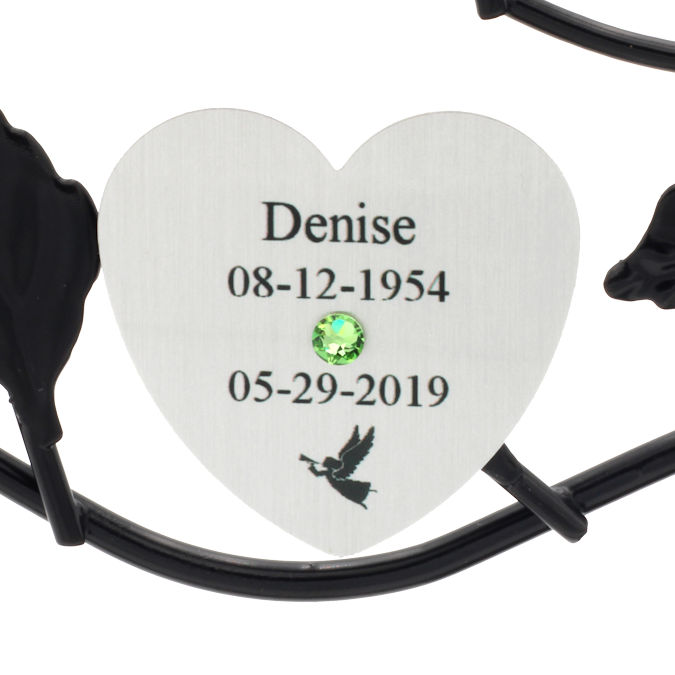
Details & specs
| Full listing name | Angel and Death Date Engraved Family Tree Silver Heart |
| Brand | Love Is A Rose |
| Product type | Platinum & Silver Roses |
| Sold by | Love Is A Rose |
| Feed price | $35.05 USD |
| Availability (feed) | In stock |
| Captured | 2026-09-23 08:34 UTC |
Sources
- Supporting a friend or loved one — Hospice Foundation of America
- When you are grieving — Hospice Foundation of America
FAQ
Is a keepsake appropriate instead of flowers at the funeral?
They serve different purposes. Flowers are for the service itself and are expected there. A keepsake is a private object for afterwards, and generally lands better once the arrangements are over.
What if I did not know the person who died very well?
Then a card, a specific offer of practical help, or a memory of them is more appropriate than an engraved object. Permanent, personalised keepsakes usually come from close family or lifelong friends. If you knew them, sharing a fond memory is welcomed — the Hospice Foundation specifically encourages it.
Is it too late to send something months after the death?
No. Support tends to thin out after the first weeks, so something arriving at three or six months, or on the first anniversary, often means more than it would have at the time.
What should the engraving say?
Name and dates are the safe default, because they are factual and cannot read wrong on a bad day. If you want to add a line, keep it short and about the person rather than about loss. Check the wording with someone close to the family first.
Does this catalog have urns or memorial jewellery?
No. The memorial range here is cased roses, an engraved bud vase and engraved family-tree hearts. There are no urns and no wearable items in the current listings.
More guides
- Gold-Dipped vs Gold-Trimmed vs Preserved Roses: Which Lasts, Which Looks Real
- Anniversary Gifts by Year: The Traditional List, the Modern List, and Which Roses Fit Each Year
- How Long Do Preserved Roses Last, and What Actually Ruins Them?
Editorial conclusions are drawn from the Love Is A Rose catalog data and the manufacturer documentation listed above; we do not claim to have used every product shown. Updated 2026-08-25. Corrections: contact us.